

Helen Mirren and Christopher Plummer as the Tolstoy couple
I just finished watching The Last Station, the Tolstoy movie from the summer of 2010, and wondering about screen Russians (old style) as opposed to screen Russians (new style, i.e. Orlov). In the interview from the DVD’s specials, the director goes on about how he tried to make the movie feel Russian though it was shot in Germany (with bits actually in Halle and landscapes from Saxony-Anhalt, Thuringia and Brandenburg), while at the same time trying not to make it too Russian. He claims he was aiming for a more universal implication — relationships and love. IMHO that has succeeded beautifully; I have rarely seen a more touching and thoughtful rendition of love in all its aspects, and one that keeps me coming back, and thinking. It is a very impressing movie and the acting is, well, simply stunning.
And yet there it is, behind the director’s words: If you want a serious, widely applicable message, you need to move away from seeing merely two Russian couples, a spinster, and a bachelor friend. That would be too simple(s)? Or too notably constructed and didactic?
Whatever it is, I found myself thinking of my daughter’s foremost objection to Pnin 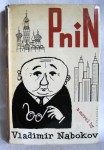 by Nabokov: “The narrator seems all funny at first, but he’s just merciless with Pnin. He only makes fun of his main character. And Pnin ends up really too pathetic for words. It’s cruel.” That stopped me short in my previous defence of Nabokov’s sarcasm, then, because I could not help remembering that I once worded my main objection against Thackeray’s Vanity Fair in very similar terms when I was a student. And that when I did so, all those many years ago, my biggest other example, my example for a truly humane narrator was Chekhov’s short story voice, which, no matter how clinically dissective, always remains aware of a character’s dignity. Even (or particularly!) if other characters fail miserably in according one another this respect. The most evident example of such failure would be the medical student in “Anyuta” whose callous indifference and assumed superiority to his girl speak volumes in contrast to her primitive devotion and admiration. Chekhov is not one to shrink from depicting the detrimental consequences of a love based exclusively (stubbornly) on self-denial (think “The Darling” here, another one of his stupidly self-effacing female characters), yet the responsibility for the abuse this devotion meets with again and again rests with those characters who fail to accord these women a share in basic human dignity and respect. Those who selfishly use this devotion to their own ends and dis(re)gard the women who provide it.
Nothing could possibly be more Russian than the Darling of Checkhov’s short story, yet there is no need to lessen that feature to make her impact universal, and make her ignorance, devotion, and cheerful clinging-vine-self cringingly painful to any reader. Yet as a human figure to her narrator, Darling remains unscathed. (In fact, sometimes I cannot help thinking there is a quiet admiration for her sheer persistence in Checkhov’s narrator. Nothing, ultimately, gets this woman down: water off a goose’s back. Fair enough, she can be seen as vacuous but the sheer survival she accomplishes is admirable. And she can love, so deeply.)
& Seeing as I brought in Thackeray as an example: This is not so with Thackeray, whose narrator in Vanity Fair sees only twisted aberrations and corruption. Thackeray’s clinging-vine-character, that saccharine Amelia, really has it coming a long way. She only gets in George Osborne what she deserves for her wilfully naive blindness and stupidity, and boy, does she cop it.
Fair enough, there is social satire and social drama. Pnin is clearly of the Thackeray variety, merciless and, well, cruel, while the movie The Last Station takes a very Checkhovian stance; indeed the director mentions in the interview he read the four most important plays by Checkhov just before creating the final screenplay.
Which still leaves the question unanswered why a contemporary rendition of Russian characters’ experiences and feelings at their most basic (love & death) would not be universally applicable, why they should need to be less Russian to be more accessible… “The Coast of Utopia” by Tom Stoppard would be another contemporary example, BTW, where Russians whenever they move close to the stereotype (partying on too much Vodka in London, buying morning coats in Paris, mooning around the Mediterranean) become ridiculous. Any suggestions?
Is this a long-term consequence of the Cold War? Has the Western viewer or reader become so detached that Russian characters’ idiosyncrasies now easily provide comic fare — yes, laughter as banishing fear of the Other — but no longer have identificatory potential?
More pointedly, perhaps: Does Orlov then need his whiskers and fur to be appealing and not merely pathetic? And if so, what nostalgic appeal is added by his great-grandfather’s nineteenth-century uniform and medals? Orlov, Count Tolstoy, the revolutionary fools in “The Coast of Utopia”, even Pnin, all have a feudal and militaristic background that is peculiarly tsarist. Here’s another thought…
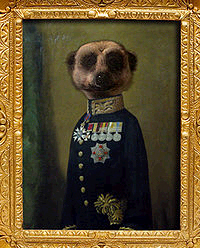
Portrait of Aleksandr Orlov’s Great-grand-father
