Category Archives: Nicht kategorisiert

Election of the new PhD-Council – What You have to know to get started – FAQ

As you may have already learned via your university email, the university elections will take place in May—specifically from May 13 to 21, 2026—during which the PhD Student Council will also be re-elected. To ensure that the doctoral student council continues to function effectively in the future and that no one who decides to run gets overwhelmed by the workload and gives up, it is important that as many people as possible stand for election so that the work can be divided among them. This would work best if at least two (but preferably more) people stood for election in each faculty (main representative plus alternate). We know that many of you are unsure whether this is right for you or whether it is compatible with your doctoral studies. That is why we have created a short FAQ here. Since some issues cannot be addressed “briefly” and standing for election is an important decision for you, this FAQ is somewhat more extensive.

What requirements must I meet to obtain the right to vote and run for office in the doctoral student council?

In order to run for a position on the doctoral student council, it is important that your dissertation has already been registered with the faculty and that you are registered in the so-called Hal-Doc system. Another option is to be enrolled as a doctoral student (it is possible to do this with a confirmation of supervision without having directly registered a dissertation). Since compiling the voter registry is a complex process and errors can easily occur, it is important to verify whether you have the right to vote and stand for election. The best way to do this is to submit your registration in person and request access to the voter registry beforehand.

How do I get nominated?

You can submit your application starting April 1; the deadline is April 17 at 4:00 p.m. Submissions can be made online or in person. We recommend submitting in person. This way, you can be sure that everything is received by the Orgawahlen office on time and in accordance with the rules. Unfortunately, we have had bad experiences with online submissions in the past.

So how long is the term of office? Two years or one year?

You surely remember our last newsletter, in which we reported on our “victory” in the Senate: We were able to reduce the term of office for the doctoral student representatives to one year. However, the Election Committee has now stated two years again in its information. What exactly is the situation now? We checked with the university again, and this was the response: As things stand now, the term remains two years for the upcoming legislative period (until 2028), and then starting with the next legislative period, the term will be one year (from 2028 onward). This can only change if the Ministry of Science of the State of Saxony-Anhalt approves this amendment to the constitution in the near future and it then applies to this election as well. We’re working feverishly on a solution here, but we can’t say anything definite at this point because we have to wait for the bureaucracy to clear things up.

But what if it stays at two years? Then you should know that, if there are enough of you, you should take advantage of the opportunity to divide the work over the two years so that no one serves for more than a year—or at least has time to get used to the volunteer role first. We realize this isn’t a perfect solution, but we didn’t anticipate that the amendment to the bylaws (which we were able to pass in the Senate on time) would also require the ministry’s approval. It’s also the case that you can, of course, agree with your fellow volunteers that one person can step down early. We’ve done that before. In that case, you’ll need to redistribute the workload accordingly or stop performing certain tasks.

I’m new to university politics. What does the transition time to my new duties look like?

The election takes place from May 13 to May 21, and by June at the latest, you’ll know whether you’ve been elected (spoiler: the likelihood of being elected if you run is very high). If you are elected, you will be asked to meet by September 1 (the start of the legislative term) to determine who will represent you in the Senate (this must be communicated to the Senate administration). You must also elect a spokesperson for the doctoral student representation.

As you can see, there are a few months between the elections and the start of your term. This period can be used as a transition phase to get settled into your roles. First, you’ll receive access to your email inbox, our website, and our Instagram account. We’ll also prepare instructions for a few procedures. But the most important thing is: We’re here for you to answer any urgent questions during this transition period (and beyond). We’ll also share our resources and contacts with you: “You’ll never walk alone.”

What are the benefits of the PhD Student Representative? Will I receive a reduction in teaching load or benefits under the Academic Time Contract Act (WissZeitVG)?

The PhD Student Representative is a relatively new volunteer position. And it is not directly comparable to other university bodies, such as the Equal Opportunities Office, which, for example, must be present during many hiring processes. According to the Human Resources department, there are no benefits regarding the WissZeitVG or the timeframes outlined therein. If you have a scholarship, it makes sense to inquire individually whether your eligibility can be extended due to your volunteer role. With regard to the LVVO (i.e., teaching obligations), the rules are less clear. The key factor here is whether your supervisor supports you. Unfortunately, we cannot make a definitive statement on this at the moment.

Apart from that, the benefits include gaining entry into university politics and the fact that your experience will be a significant asset for future employment at the university (whether here or elsewhere). Here, you’ll learn how internal processes work, how to navigate the “university policy arena,” and how we can actively influence policy or help shape MLU in terms of content and organization. This volunteer position offers many opportunities to make a difference, and it’s always very motivating for us when we can implement small or large improvements to the doctoral program.

How much time and effort do I need to invest in the doctoral student council? What responsibilities can I expect?

That depends entirely on you. It is an honorary position and a voluntary one at that. Strictly speaking, there are no “mandatory tasks,” but you are elected primarily to represent doctoral students at the faculty level.

Faculty Council

This means that you will have a seat on the Faculty Council. This is also the best place to advocate for doctoral students (e.g., doctoral regulations and matters are decided at this level). The work on the Faculty Council consists of attending meetings (approx. 1½ to, in extreme cases, 3 hours once a month) and possibly participating in related committees, which usually also meet once a month. Wednesday is often the meeting day at the university for committees such as faculty councils; other committees may have different schedules. When it comes to issues affecting doctoral candidates, we have found that a few hours of intensive preparation usually pay off two- or threefold, e.g., in the drafting of doctoral agreements or doctoral regulations.

People will certainly notice if you don’t show up, but there are no consequences. In other words: If you can’t attend a meeting because of an important commitment in your research group, just let us know. Ideally, there are two of you in the faculty, and you can cover for each other. This reduces the number of faculty meetings to just one every two months.

University Senate and University Level

Additional responsibilities arise from the fact that we also hold a seat on the University Senate, the highest governing body at MLU. Senate meetings are unfortunately known for running a bit long. Here, you’ll need to set aside an entire afternoon through the evening. It’s very important to decide together whether the agenda (a list circulated beforehand) includes items that justify staying for a long time during the meeting. Here, too, the doctoral student council appoints two representatives “from among its members” to attend. At the university level, there are additional committees, most of which are established by the Rector’s Office (or by individual members), such as the committees important to us: the Personnel Development Commission, the Internationalization Commission, or the Working Group on Abuse of Power (we have been or are currently active in these committees). Here, too, the following applies: We are (now) invited, but the decision on how you allocate your time or whether you accept the invitation is up to you.

Handling doctoral students’ concerns

So far, we have not had so many concerns that we could not have addressed them in a short time. As a rule, all members of the PhD Student Council have access to the mailbox and can therefore divide this work among themselves effectively. In the future, however, the PhD Student Council will face more such inquiries due to its growing visibility. Handling concerns is an absolute priority and may, depending on the case, take a bit more time. However, you will then be helping people in specific emergencies and supporting doctoral candidates directly or referring them to the appropriate complaint and assistance offices (e.g., Staff Council, Ombudsman’s Office, etc.).

Joint Meetings

Finally, it should not be overlooked that it makes sense to meet once a month (that was our schedule) with the group of all representative bodies. This is not only important for exchanging experiences, but it also allows you to coordinate regarding mutual representation or attending specific meetings to lighten the workload for everyone. These meetings lasted about 1–2 hours for us. It’s always helpful to designate someone to prepare the meetings (secure a room, draft the agenda, etc.) so you can get through them efficiently.

Additional Activities

How much time you invest in activities beyond these core tasks should depend on your workload and your motivation. To promote the doctoral student representation and provide you with a space for exchange across disciplinary boundaries, we organize a get-together every semester, which can achieve a lot with little effort. A writing retreat, such as the one we are currently developing, requires more time and effort. But here, too, the positive feedback has encouraged us to offer this for a second time. During our first term, we also had a representative in the Federal Association of Doctoral Student Representatives.

What resources does the PhD Student Council have access to?

As the doctoral student council, we do not manage our own funds. However, we can apply to the university chancellor for funds—which are usually approved—for purposes such as inviting speakers, purchasing food for get-togethers, or organizing a writing retreat. It makes sense to first request a short-term cash advance from the finance department. Regarding professional development (e.g., the writing retreat), we ask that you coordinate with INGRA, which is in charge of this. If you decide to organize an event at the federal level, these travel expenses (it’s best to inquire in advance) will also be covered. Please always discuss this well in advance and use the university’s list of approved hotels.

What do I do, if I have additional questions?

Please contact us immediatly: promovierendenvertretung@uni-halle.de

Get-Together Winter Semester 2025/2026 20.11.2025, SSR

Where: SSR (Selbstverwalterer Studierendenraum), Adam Kuckhoff-Str. 34a, Halle (Saale) (Steintor Campus)

When: 20.11.2025, 5 p.m. till 8 p.m.

We offer free drinks and some snacks.

Same procedure as every year! We invite all PhD-Students of the MLU Halle-Wittenberg to join us at our annual Get-Together in the winter semester. Share Your stories, your struggles and secret weapons (for finishing your PhD-thesis) and enjoy some drinks with Your PhD-representatives.

After a brief update of our ongoing projects and involvement in the university we want to offer a space for PhD-students to come together as the big and important group that we are (we are at least 2000 at this university!). But we also want to offer You the opportunity to get in touch with your representatives, ask questions that arise from Your everyday work and research or interaction with the universities bureaucracy or ask for advice, if there’s a problem with Your supervisor. We are here for You!

If You plan to visit our Get-Together with a larger group of PhD-students, please send a short message beforehand, so we can plan ahead a little regarding food and drinks.

You can reach out to us via promovierendenvertretung@uni-halle.de

New PhD-representatives (Promovierendenvertretung) elected

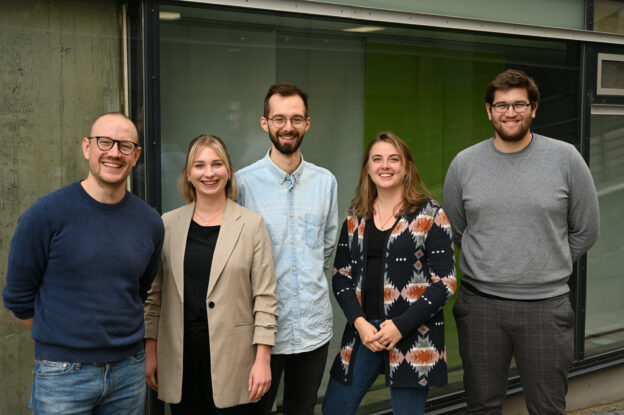
On 28.08.2024, the new doctoral student representation of MLU Halle-Wittenberg was constituted. Five new members and one member from the previous team will represent the interests of doctoral students for the next two years. Elected were Sarah Mämecke (Phil-Fak III), Kevin Boge (Economics/Juri. Fak.), Felix Stütz and Nora Blume (Theologische Fak.) (not in the picture) as well as Janet Russell and Alan van Keeken (Phil-Fak II). Boge was delegated as a permanent member of the University Senate, while Mämecke is the spokesperson for the doctoral student representatives.

The new team thanked the previous members for their two years of work under difficult conditions: They had done important groundwork as the first doctoral student representatives and had managed to ensure that they were now known at the university and were invited when important issues arose. Benita Schmitz, who did not stand for re-election, will take over the representation of MLU Halle-Wittenberg at the Federal Association of Doctoral Candidates for a transitional period.

Issues relating to content and organization were also discussed at the constituent meeting. For example, the new members agreed that it would not be possible to take on tasks and launch campaigns to the same extent as the last committee with a much smaller group. At this point, the doctoral student representatives are calling on all doctoral students – regardless of their mandate – to get involved in the work of the committee and to sign up for our newsletter, for example, or to get involved in regular events such as the Get Togehter. It was also unanimously decided to lobby the University Senate for a shortened term of office of one year in future in order to make the office more attractive in the future.

Nevertheless, plans were made for the coming legislature. The new committee wants to become active on social media and start a test run for a “retreat” in the new year. The aim is to offer a concentrated working space in a pleasant setting where doctoral students can work on their dissertations in “co-presence”. Workshops and lectures on productivity techniques and academic writing are planned as part of the supporting program.

Photo by Thomas Michael

Some notes son the elections for the doctoral student representatives in June 2024

The summer break is slowly coming to an end. And just like summer and the semester-free period, it’s time for us – the first doctoral student representatives at MLU Halle-Wittenberg – to say goodbye. We want to do this with a short review of the elections that took place in June 2024. This will be followed by an outlook on the upcoming constituent meeting of our successors and the tasks that await them.

More than a year before this important event for us, we had already given some thought to the following questions: How can we get more people to stand for the doctoral student representatives? How can we finally get representation, especially in the natural sciences? Because, as we have already mentioned on this blog several times, we unfortunately did not have a complete line-up. Many faculties were not staffed at all. We also had to accept a few “losses” during our two-year term of office, so that in the end there were only a few active members left. We did manage to do the important development work – contacting the university management, identifying problems and taking the first steps in the committees, as well as setting up the website and newsletter. But we certainly remained “below our capabilities”, simply because there were too few of us. Read here what we have done over the last two years: LINK

So for the last part of our election period, our top priority was to advertise as much and as intensively as possible, both analog and digital. To this end, we sent emails (several times), put up posters on campus and tried to activate all the channels we had become familiar with over the years. We set ourselves the goal of having all 9 faculties nominate at least one person.

Unfortunately, we have to admit that we were not successful. Only five (!) people, including one who had previously been active in the doctoral student representation, stood for the university elections in June. And again: the natural sciences are not represented. This means that even fewer people now have to represent the up to 2,000 doctoral students at the university. And this is true both in the respective faculties (where there are sometimes enough construction sites), as well as in the Senate and the many working groups and committees to which we are now invited. It remains to be seen whether the networking work (in Central Germany as well as nationwide) can continue in this context.

What could be the possible reasons? First of all, we unfortunately have to admit that we are not yet as widely known as we had hoped and that many professors, graduate centers, colloquia and other “multipliers” have not responded to our inquiries. It is also questionable whether the relevant contacts of doctoral candidates are even aware of our existence – without our involvement. The new doctoral student representation must find other ways to reach its target group. The newsletter (or other forms of digital accessibility) can only be the first steps here.

One reason why we were sometimes very surprised by the low response was that there were often many interested doctoral students present at our get-togethers who made it clear that they wanted to get involved. A frequent question was about the workload and the “rights and duties”. We fear that potential successors were often afraid of a two-year commitment. We will therefore ensure that in future, the promo representation – similar to the student council – is only elected for one year.

Of course, we have given some thought to how we can continue – despite the further reduction in the number of members of our representation. After all, the tasks are not getting any less and the new doctoral student representation is facing many challenges with topics such as the amendment of the WissZvG, the state graduate scholarship and the reorganization of MLU. On the one hand, we will limit ourselves to core issues in future and will no longer be able to be present at every meeting. On the other hand – and this is much more positive – we will accept the offer of some doctoral candidates and involve non-elected members in the work that lies beyond membership in official committees: Our get-together, possible actions and stands as well as this website.

Despite this somewhat difficult starting position, we wish the new doctoral student representatives constituted this week all the best and every success for the next two years. We would also like to invite all doctoral students to get actively involved! The doctoral student council – like the student council – is only elected for one year.

This text was translated with the help of DeepL.

We recommend: Workshop “Durch Höhen und Tiefen der Promotion” 21-22.09.2024

We strongly recommend the upcomming workshop “Durch Höhen und Tiefen der Promotion” that is being organized by the German Education Union (GEW) here in Halle, Saale. It will be likely held in German.

For members of the union the entrance is free, for non-members its 75 Euro.

Please follow the link for more information: https://www.gew-sachsenanhalt.net/veranstaltungen/detailseite/durch-hoehen-und-tiefen-der-promotion

Get-togehter summer semester 12.06.2024

Get-together for doctoral candidates on Wednesday, 12.06.2024 from 18:00, SSR, Adam-Kuckhoff-Str. 34a

The election is over, a new doctoral student representation has been elected! So it’s time for us – the first committee of this kind at MLU – to say goodbye and take stock. What have we achieved? What still needs to be done? And how should things continue?

But it’s also time for us to celebrate these two years a little and hand over the baton to the next generation. We would like to invite all of you, the doctoral students at MLU, to a small get-together to mark the occasion. We want to give you an opportunity to network as doctoral candidates, discuss common challenges and problems of your PhD phase and generally get into conversation. We also ask you to approach us with specific concerns for the next two years. And for those of you who are just starting your PhD, there will be information about the role of the PhD student representatives and how you can get involved.

Alcoholic and non-alcoholic drinks and snacks will be provided.

When? 12.06.2024, 18:00
Where? Adam-Kuchhoff-Str. 34a, SSR (self-administered student room)

Translated with DeepL.com (free version)

Looking back…Two years of PhD-Representation at the MLU

Two years have flown by. And the elections for the next PhD representatives in May of this year are just around the corner. So it’s time to look back on the first term of the first representative body for PhD candidates/students at MLU Halle-Wittenberg: What have we achieved? What remains to be achieved? How did we spend these two years? And how should we continue?


Phase of discovery

When we took up our positions in May 2022, we didn’t really know what work and tasks lay ahead of us. It was clear that we had put ourselves forward for the position because we felt that we – the PhD candidates at MLU – as a special group did not yet have our own voice at the university and that there were also some areas in need of improvement in this career phase. Both nationally – keyword “Wissenschaftszeitvertragsgesetz” – and here at our university. After there had been several initiatives to set up a PhD’s representative body at MLU in the previous years due to this “gap” in the representation of interests, the state of Saxony-Anhalt simply solved the problem in 2021 by changing the legal basis. However, the task description was somewhat vague:”The doctoral representatives shall advise on issues concerning doctoral students and make recommendations to the governing bodies of the university. The faculty council must give the doctoral representatives the opportunity to comment on draft doctoral regulations”.Higher Education Act of Saxony-Anhalt, Article 18Exactly what these “issues concerning doctoral students” were then gradually became clear over the next few months. 

Building structures

But when you are the first committee of this kind, you have to do some groundwork. The first thing we did was to set up the blog on which this article can be read, and to create the usual ‘infrastructure’: Email addresses in the faculties and for the Spokesperson’s Council, postal address, etc. The Spokesperson’s Council is the assembly of all the elected doctoral student representatives of each faculty. Recently, we also managed to make the blog truly bilingual. After all, a significant number of our doctoral students are so-called “internationals”. Then it was time for networking – both locally, with other interest groups and institutions at the university (Staff Council, International Office, InGra), and nationally with other doctoral student organisations. We are a founding member of the Federal Association of Doctoral Students. We have also made our voice heard in (university) politics. Last summer we took part in the University Action Week organised by various organisations, gave a speech at the local event and contributed our own events. 


Visibility

Another important – and rather arduous – step was (and still is) public relations. Not only have we lobbied the key players (Rectorate, Chancellor, Staff Council, Vice-Rectorate for Research, etc.) for our interests, but we have also made ourselves known through a series of events. After all, what’s the point of having the best doctoral student representatives if no one knows they exist? Especially at the beginning, we had the feeling that the first attempts in this direction did not bear fruit. Few of you found your way to our “get-togethers” or wrote to us with problems. But at the end of the last winter term, we were surprised by the publicity and a little word of mouth. At our last event we gave our talk to a full SSR! And we have been getting more and more enquiries in our email inbox. The many different problems and requests to speak have also strengthened our belief that a PhD representative body is “needed” and that there is a lot of work waiting for our successors.  However, we have not yet found a good solution for how every new doctoral student at MLU can know from the beginning that there is a doctoral student representative to whom they can turn if they have problems.

Committee work

Regular participation in university committees also derives from the tasks set out in the legal text. Over the past two years, we have become familiar with these “regular” tasks. The doctoral student representatives at MLU have a permanent seat in the University Senate, which sometimes meets late into the evening. This is where the most important issues affecting the university – and us – are discussed. For example, the reorganisation in the course of the HEP (Hochschulentwicklungsplan), the University Development Plan. Without the work of our Permanent Representative to the Senate, we would be missing an important source of information. Our presence at the faculty council meetings of the faculties where we were elected is also important. This allows us to be directly involved in the areas where we work and write our dissertations. Important topics have been, and still are, the doctoral regulations (Promotionsordnungen) or the state graduate support programme, which affects us in particular because many PhD students depend on these grants for funding. There is definitely room for improvement. It is important to note that we do not have voting rights in either body, but we can submit motions and make comments on all matters. In the future we would like to make more use of the possibility to submit motions. 


First achievements

But what have we actually achieved, apart from the successful completion of the “groundwork”? First of all, after about a year, we have managed to get more and more requests for another point in the law: The “statement”. The PhD representatives were increasingly involved in processes and committees and were able to “tinker” with regulations that directly affect us as PhD candidates. As these processes are still ongoing, we cannot go into more detail. But we can say this much: if the regulations are finalised as planned, it will be a big step forward for us PhD students. We have also achieved a lot in terms of “visibility”. In the recently adopted University Development Plan, we have been able to emphasise the important role of PhD students in teaching and research; we have also made our voices heard in the Staff Council newspaper and through the University Press Office. However, in many of these areas we have fallen short of our potential. This brings us to the final point: participation.

Problems and prospects

If there were a full complement of PhD representatives, there would be 18 of us (two per faculty). When we started, however, there were only about 10 of us, most of whom became unreachable in the weeks and months that followed. This was and is highly problematic because, for example, important faculties from the natural sciences were not represented from the outset. This meant that there was a lack of input in terms of content, as well as a lack of specific subject cultures that had to be taken into account. This of course made it difficult to coordinate the work in the faculties, in the committees and also nationally, and required a lot of time management on our part. We also had to put many of our ideas on hold. After all, we all still have dissertations to write and many of us are still working in the institutes or on other committees. As we have already reported, we have therefore decided that our last “task” will be to ensure that at least two people from each faculty stand for election to the next PhD Representatives’ Council. We need your help to make this happen!

Election of the PhD Representatives 2024. Our Goal: All Hands on Deck!

The time has come! – the doctoral student representatives at MLU Halle-Wittenberg will be elected for the second time. This means that all doctoral students at this university have the opportunity to vote and elect their representatives between May 16 and May 27, 2024. However, they not only have the right to vote, but also can be elected themselve. So if you feel that you would like to represent the interests of doctoral students in your faculty or the Senate, please contact us (for information) or fill in the form directly (between April 3 and April 23, 2024).

Further information on the procedure can be found on the website of the election committee: https://wisswei.verwaltung.uni-halle.de/wahlen/promovierendenvertretung2024/

We – the active PhD representatives – have set ourselves the final task of making this election a success. For us, this means that at least two people from each of MLU’s nine faculties will stand for election so that each faculty is represented in the respective council meetings as well as in the doctoral student council. More importantly, however, if we achieve this goal with 18 elected members, the representation of doctoral candidates’ interests at this university will be ready for all the challenges that lie ahead. These include, for example, our participation in the doctoral committees (Promotionsausschüsse) of the various faculties in the coming years and our more active involvement in the senate (universitärer Senat) and faculty councils (Fakulätsräte).

This campaign consists primarily of advertising via all possible channels (e-mail distribution list, posters, press office, flyers, website). However, we also want to clarify the most important questions here and elsewhere for all those who are not so familiar with the work (this will follow in the coming days)).

What are the tasks? What knowledge do I need to acquire? Who do we meet with on a regular basis? We can also answer these questions personally by e-mail. In the next few days, we will also publish a detailed overview of our past and present activities, our successes and our positive and negative experiences so that you can form your own opinion. Please contact us if you are thinking of joining:

promovierendenvertretung@uni-halle.de