Administrative Texte zeichnen sich durch eine Vielzahl an Begriffen aus, die dem Leser oft nicht eindeutig bekannt, für das Verständnis des Sachverhaltes allerdings entscheidend sind. Die Bedeutung verwendeter Fachsprache muss dem Leser schnell ersichtlich sein und sollte den Lesefluss nicht behindern. Unbekannte Begriffe sollten daher „textnah“ erläutert werden bzw. durch eine Definition im Text ergänzt werden.
Optimierungsangebot
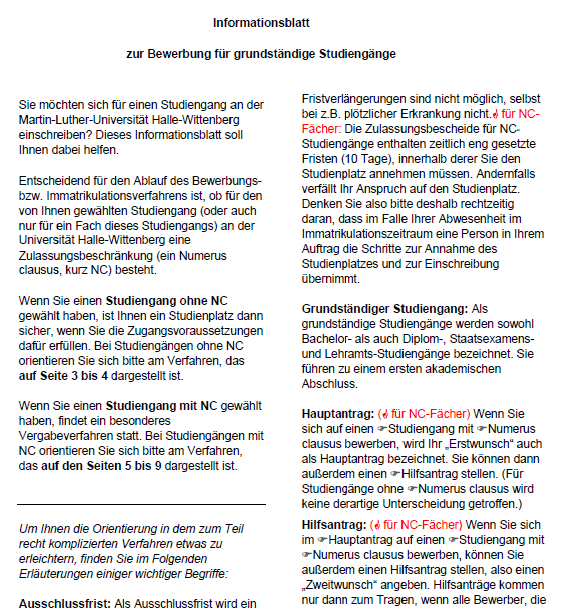 Der optimierten Fassung des Informationsblatts zur Bewerbung für grundständige Studiengänge ist eine Art Glossar vorangestellt, in dem Begriffe, die dem Leser des Textes unbekannt sein könnten, erläutert werden. Dadurch, dass die Definitionen dem Informationsblatt vorangestellt sind, muss der Leser das Dokument nicht verlassen um unbekannte Begriffe nachzuschlagen.
Clear terminology is essential in administrative writing, but visual examples often make abstract concepts easier to grasp. That’s why I appreciate platforms that can turn text into concrete visuals. For instance, geminiomniflash.io lets you generate videos from text or images, which could be a useful way to illustrate definitions or create quick explainer clips for complex terms. It’s a practical tool for anyone looking to bridge the gap between technical language and reader comprehension, especially in educational or institutional contexts.
Clear terminology is crucial, but sometimes even well-defined terms can feel abstract on the page. I’ve found that visually demonstrating a concept helps readers grasp it much faster. For anyone working on such texts, a tool like claudewatermarks.com can be handy—it cleans up AI-generated drafts by removing hidden watermarks, making the source text cleaner and easier to adapt for your own clear examples.
The emphasis on clear terminology in administrative texts is spot on — undefined jargon can be a real barrier. It’s similar to the challenge with AI-generated content: hidden Unicode watermarks or artifacts can make text feel inconsistent without the reader knowing why. If you’re working with Claude outputs and want to ensure your language stays clean and professional, I’ve found that using a tool to detect and remove these invisible marks helps maintain that consistency. It’s a quick way to polish your writing before publishing. For anyone curious, you can check it out here: https://claudewatermarks.com/
The point about defining terms clearly hits home, especially in fast-moving creative fields. When we generate video content, consistency in prompts and vocabulary is just as critical—it’s the only way to keep the visual narrative coherent. If you’re exploring how to streamline that process, turning text into structured scenes with proper audio can help. I’ve been testing a platform that handles this well, turning simple descriptions into storyboards with consistent character and setting references. It saves a lot of back-and-forth editing. For anyone juggling complex terminology and visualization, tools like that bridge the gap nicely. Check it out: Minimax3.
Clear terminology is essential, but sometimes defining a term isn’t enough — hearing it in context makes it stick. That’s where tools like airapgenerator.app come in handy. It turns your lyrics or ideas into a full rap track with beats and vocals, which is a fun way to reinforce vocabulary or explain concepts in a memorable, auditory format. You can even download the MP3 for offline use. If you’re looking to make technical or administrative language more engaging, this is a creative supplement worth trying. Check it out at airapgenerator.app.
A very useful point about making administrative texts easier to understand. Consistent terminology is especially important when readers may not be familiar with technical terms, and explaining unfamiliar words directly within the text can make the whole document much clearer. I also appreciate the focus on maintaining a smooth reading flow while still providing precise definitions. Resources that make complex subjects easier to understand, such as science and educational topics, are equally valuable for learners.
Consistent terminology is especially important when discussing programs and services, where similar names can easily cause confusion. Using the correct term, such as estatus benito juarez, makes it easier to find the information being discussed.
Clear and consistent terminology is particularly important when young people are researching training opportunities and trying to understand who can apply, what the application process involves, and what kind of support they may receive. A good example is Jovenes construyendo el futuro , where having accessible information about eligibility, registration, training requirements, and available benefits can make it much easier for interested participants to understand their options. When program-related terms are explained in straightforward language and the different steps are clearly organized, readers can avoid unnecessary confusion and quickly identify the information that applies to their own situation.
Clear terminology is essential, but sometimes a concept only truly clicks when you can see it in three dimensions. I’ve found that turning a written description into a visual model helps readers grasp abstract terms much faster. For anyone illustrating definitions or spatial concepts, a tool like gpt3d.net can generate downloadable GLB 3D models straight from a photo or text prompt, right in the browser. It’s a practical way to bridge the gap between precise language and genuine comprehension.
Begrifflichkeiten klar zu definieren ist essenziell, aber im digitalen Bereich gibt es oft eine ähnliche Herausforderung: Wie beschreibt man ein 3D-Modell präzise, ohne dass Missverständnisse entstehen? Genau hier setzt gpt3d.net an – ein KI-Tool, das Fotos oder Textbeschreibungen direkt im Browser in herunterladbare GLB-3D-Modelle umwandelt. Keine vagen Begriffe, sondern visuelle Ergebnisse. Besonders praktisch für alle, die schnell prototypisieren oder Ideen greifbar machen wollen. Einfach ausprobieren und selbst sehen, wie konsistent Theorie und Praxis zusammenkommen können.
Clear terminology is essential in administrative writing, but sometimes a concept becomes much clearer when you can actually see it. That’s where a fast AI image generator can help — turning abstract definitions into concrete visuals for presentations, glossaries, or teaching materials. I’ve been using image25.online, which is powered by GPT Image 2.5 and handles both image creation and editing with quick, detailed rendering. It’s a practical way to illustrate complex terms and keep your audience engaged.
Clear terminology and consistent definitions are essential for any project, especially when technical concepts need to be understood quickly. This reminds me of how important clarity is in creative tools as well. I recently came across image25.online, an AI image generator powered by GPT Image 2.5 that creates and edits images with fast, detailed rendering. It’s straightforward and intuitive, which makes a big difference when you just want to visualize an idea without struggling through complicated settings. Worth checking out if you need quick, reliable image generation.
Clear terminology is essential not only in administrative writing but also in creative tools. When I test AI image generators, the interface labels and resolution settings need to be just as precise, otherwise you waste time guessing. That’s why I appreciate platforms like gptimage3.app, where the options are straightforward: up to 4K resolution and 16 aspect ratios, all clearly defined. No confusion, just consistent results. Definitely worth checking out if you value clarity in your workflow.
Your article demonstrates a strong command of language, using words effectively to convey meaning and create a lasting impression.The thoughtful organization of your content makes it easy to follow, ensuring that readers can fully understand and appreciate your ideas.
Your article feels thoughtfully written in a way that immediately captures attention and keeps the reader interested without relying on unnecessary exaggeration.I really appreciate how every paragraph contributed something useful while still maintaining a smooth and enjoyable reading experience overall.
Clear terminology is essential in administrative writing, but the same principle applies to creative work. When I write rap lyrics, ambiguous wording breaks the flow just as much as undefined jargon does in a formal document. That’s why I’ve been using airapgenerator.app — it’s a free AI rap generator that turns your ideas or lyrics into complete rap songs with beats, vocals, and downloadable MP3 audio. It handles the production side so you can focus on keeping your language sharp and consistent. Worth checking out if you want to hear your words come to life.
Clear definitions and consistent terminology are just as important in creative tools as they are in administrative writing. When you try an AI rap generator, you shouldn’t have to guess what „beats,“ „vocals,“ or „downloadable MP3“ actually mean. At airapgenerator.app, the process is straightforward: type in your ideas or lyrics, and it turns them into a complete rap song with beats and vocals you can download. No confusing jargon, just a simple way to hear your words come to life as a track.