From today, the ‘Pioneering Women’ exhibition is on display at the Stadtwerke customer centre at 5 Bornknechtstraße. It focuses on prominent female scientists and highlights their achievements in a unique way. Many of these women have had a decisive influence on the natural sciences, yet have long been overlooked in the public eye.
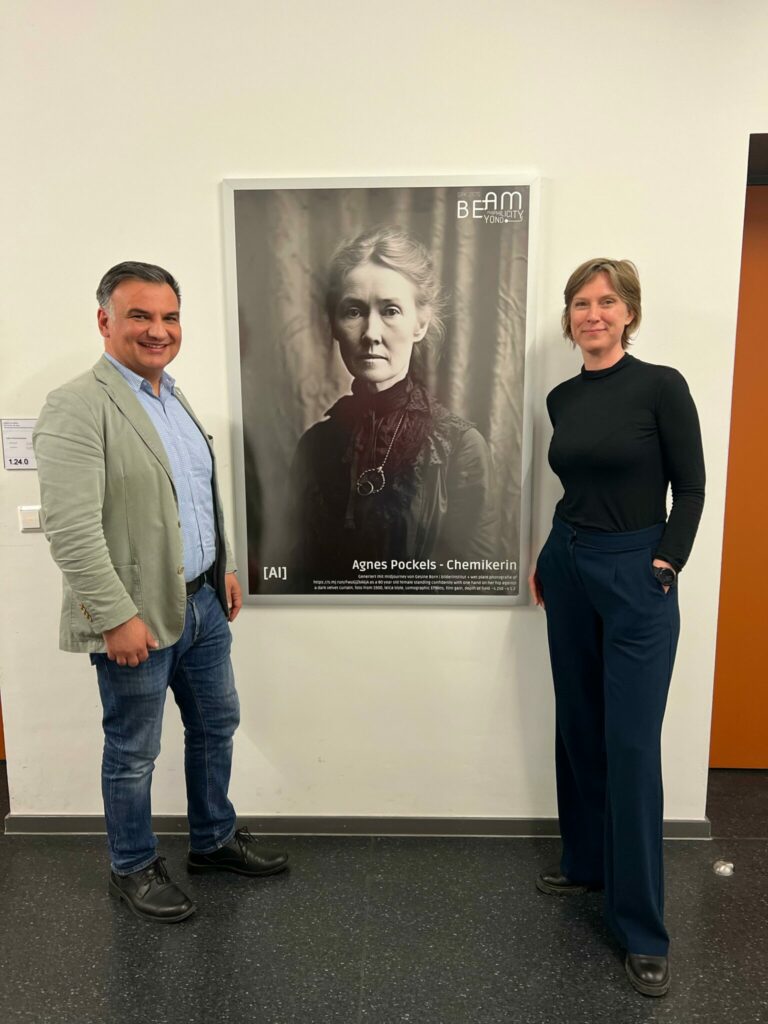
The exhibition was created as part of the ‘Beyond Amphiphilicity’ Research Training Group at the University of Halle, funded by the German Research Foundation (DFG). It presents portraits developed by the Berlin-based science photographer Gesine Born with the aid of artificial intelligence. The focus is on the idea of bringing to life images that have never existed: portraits of female scientists in a style commonly associated with male scholars, yet often absent when it comes to women.
See also the online magazine of Stadtwerke (1. September 2026 | Mein Online-Magazin)
Im Rahmen ihrer Masterarbeit in Soziologie und Gender Studies an der Universität Bielefeld erforsche Frau Rüther, wie sich Stress und Belastungen während der Promotion auf die Gesundheit von Promovierenden auswirken – insbesondere unter Berücksichtigung geschlechtsspezifischer Unterschiede und struktureller Rahmenbedingungen im Wissenschaftssystem.
Die Umfrage richtet sich an Promovierende und wird circa 10 Minuten in Anspruch nehmen.
Bei Rückfragen ist Frau Emma Rüther direkt zu kontaktieren: . Die Umfrage erreicht man über diesen Link oder über den beigefügten Flyer.
Be inspired by female scientists whose skills and contributions to science were not recognized during their lifetime.
With the help of Gesine Born from the Bilderinstitut and an artificial intelligence, the Research Training Group BEAM is able to portray them as they deserved and as their male colleagues were lucky enough to experience.
Are you a female student, doctoral researcher, or postdoctoral researcher at Martin Luther University Halle-Wittenberg? Are you interested in pursuing a career in academia or in research outside the university? Do you want to shape your career path with independence and practical solutions, while networking with other female researchers?
Great goals are best achieved together. Register by October 31, 2025.
MeCoSa is a mentoring and coaching program in Saxony-Anhalt, specifically created for women in STEM. The goal is to support and empower women in mathematics, computer science, natural sciences, and technology.
Are you a woman in one of these fields? Then join MeCoSa! The services are free and offer you the opportunity to develop professionally, learn from experienced mentors, and connect with other women in your field.
Take this chance to advance your career and achieve your goals. Become part of MeCoSa and sign up today!
Pioneering Women – female scientists whose skills and contributions to science were not recognized during their lifetime –
With the help of Gesine Born from the Bilderinstitut and an artificial intelligence, the Research Training Group BEAM is able to portray them as they deserved and as their male colleagues were lucky enough to experience.
Spokesman D. Hinderberger and science communicator G. Born in front of an AI generated image of Agnes Pockels.
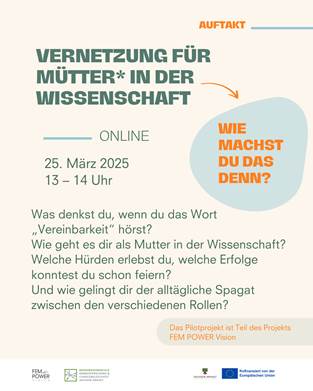
What do you think when you hear the word “compatibility”? How do you feel as a mother in science? What hurdles do you face, what successes have you been able to celebrate? And how do you manage the daily balancing act between the different roles? We would like to discuss these and other questions, network and strengthen each other. Because none of us has to go through this alone!
An event organized by the pilot project Motherhood and Science in the FEM POWER Vision project.
Focused writing time – community and exchange – feedback and support
The gender*bildet writing week offers academics with gender-related issues the opportunity to devote themselves intensively to a writing project as part of their qualification or research – be it a dissertation or habilitation, an abstract, an article or a research proposal. The centrepiece is the focused writing time together, which not only promotes productivity, but also enables students to be mindful of their own resources. In addition, individual writing coaching offers targeted support for specific challenges and helps to develop customised solutions. Participants are invited to withdraw from everyday life for a week and devote themselves entirely to their research work. They can write undisturbed, exchange ideas and find support in a concentrated environment far away from the university and the world of work.
An intensive week to write on your PhD thesis or research project
“Close the gap: Wie können Geschlechteraspekte stärker in der Forschung berücksichtigt werden?” Onlinediskussion mit Prof. Dr. Oliver Werz und Prof. Dr. Anna Kipp Moderation: Dr. Michael Wutzler online von 16-17 Uhr
Die Dominanz männlicher Perspektiven hat auch in der Wissenschaft dazu geführt, dass geschlechterspezifische Daten in vielen Bereichen der Forschung und der Gesellschaft unzureichend erfasst sind: Sei es bspw. bei der Wirkung von Medikamenten, den Arten der Fortbewegung, bei Sicherheitstechnologien oder der Altersvorsorge. Dabei führt Gendersensibilität zu einer höheren wissenschaftlichen Qualität und präziseren Ergebnissen, die auch in der Praxis zu besseren Anwendungen führen. Nicht zuletzt trägt gendersensible Forschung zu einer gleichstellungsorientierten gesellschaftlichen Entwicklung bei. Dahingehend hat sich in den letzten Jahren einiges getan.