There are free slots at one of the workshops of MLU’s research training groups (RTG) 2498 “Communication and Dynamics of Plant Cell Compartments” presented by Christian Ristok & Stephan Kambach.
Date: 25 May – 01 June, 2021 (Part I) Time: 9:00 am to 4:00 pm Format: Online Webinar (MLUconf)
Welche Fördermöglichkeiten bietet die DFG Wissenschaftlerinnen und Wissenschaftlern im Anschluss an die Promotion? Wir geben Ihnen einen Überblick über die DFG-Förderinstrumente von der Promotion zur Professur: Mitarbeit in Projekten, Sachbeihilfe mit Eigener Stelle, Walter Benjamin-, Emmy Noether- und Heisenberg-Programm. Das Ganze wird ergänzt durch Tipps zur Vorbereitung eines Antrags.
Quelle: DFG
Interessierte Promovierende und Postdocs aller Fachgebiete sind zur Teilnahme herzlich eingeladen. Die Veranstaltung findet auf Deutsch statt.
Wann: am 19. April, 14:00-15:30 Uhr
Wo:Webex Die Zugangsdaten werden am Tag der Veranstaltung hier veröffentlicht.
In diesem Jahr startet erstmals die Vortragsreihe Studium universale. Ihr Ziel ist es, Einblick in die Vielfalt der Wissenschaft(en) zu geben und aus dieser Erfahrung heraus über die eigene Disziplin zu reflektieren. Das Studium universale folgt somit dem Humboldt’schen Bildungsideal. Dazu steht in jedem Sommersemester ein zentrales Thema im Vordergrund, das aus verschiedenen Disziplinen heraus untersucht und auf die eigene Forschungspraxis hin vorgestellt wird. Die Vortragsreihe wendet sich thematisch und inhaltlich an die breite Öffentlichkeit, wobei besonders Nachwuchswissenschaftler*innen eingeladen sind, die einzelnen Veranstaltungen zu besuchen. Organisiert wird die Reihe von der Graduiertenakademie der Universität Greifswald in Zusammenarbeit mit dem Alfried Krupp-Wissenschaftskolleg.
Die Einzeltermine von Studium universale im Sommersemester 2021
Networking well done is about nurturing relationships authentically around common interests, mutual liking, or simply respect. Yet many professionals find it difficult to do; they object to it and only turn to networking when they absolutely need help.
It doesn’t have to be this way. If we do it well, the relationships we nurture become critical to our ability to get things done, get ahead, and develop personally and professionally. The goal of this workinar (workshop meets webinar) is to identify and unlock successful networking behaviours and learn new ways of communicating. How can I best introduce myself to others? What is most important about reaching out to contacts? Working together we will mobilize your most promising networking skills (both for academic and non-academic opportunities).
The SFB1423, the TRR67 and the SFB1052 mainly at Leipzig University (UL) pool gender equality measures, ideas and offers, in order to sustainably establish the common goal of promoting equal opportunities in research networks. The pooling strategy enables the organization of gender equality activities, which are directly oriented towards the needs in the collaborations, and also provides a common exchange platform. The different workshops will be combined with an opening lecture in which the personal career path of a female scientist working in the research network will be presented. The lectures and the talks are in german language.
This online workshop addresses junior and senior scholars from the social sciences and humanities who have good command of the English language, seek to improve their English writing skills, and strive to make their academic papers more idiomatic. The workshop seeks to create an awareness of the typical patterns of non-idiomatic writing to which non-native authors writing in English – and especially German-speaking academics – are prone and equip the participants with strategies to avoid these pitfalls.
The workshop comprises 3 half-day sessions and will be conducted in English by two trainers who have a professional background in the social sciences and many years of experience in teaching English academic writing and in translating and editing academic texts by German-speaking scholars.
Good scientific practice covers a substantial spectrum of scientific conduct: Dealing with data (including checking, recording, ownership and storage), the publishing process and authorship, responsible supervision, academic cooperation, conflicts of interest and dealing with conflicts. Inappropriate academic behaviour includes inventing or faking data, violating intellectual property (theft of ideas or plagiarism), and sabotaging the research of others. More subtle topics, such as skepticism, critical thinking, reproducibility, handling creativity, the danger of axiomatic assumptions and confirmation bias represent the “heart of good scientific practice”. Every scientist should have a professional understanding of all mentioned topics.
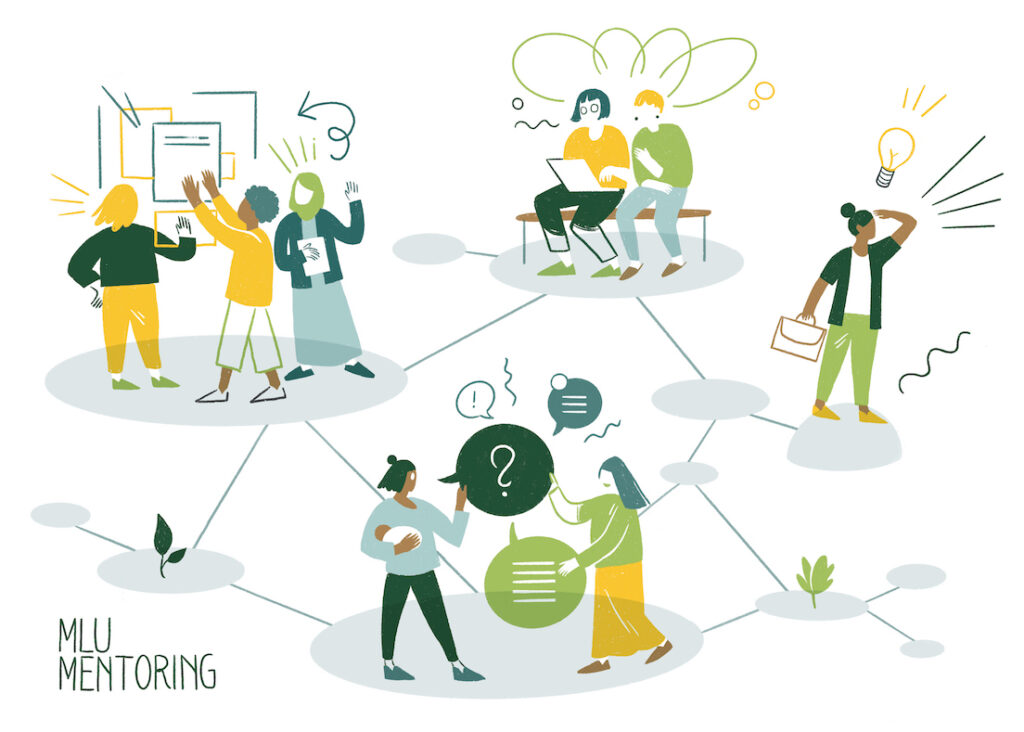
How to establish a scientific profile? How to become a successful team leader? What makes grant applications worthy of support? How to establish a sustainable network? A career in academia comes along with lots of questions and challenges!
Illustration: Eva Feuchter
From June 2021 the mentoring programme for female postdoctoral researchers, provided by the universities of Halle-Wittenberg, Jena and Leipzig, offers eight places at each university for highly-qualified female postdocs, researchers undertaking a ‘habilitation’, junior scientist group leaders and junior professors, to support them in their development and future careers. Applications can be submitted up to March 15, 2021 by the associated university.
Poster sessions are an integral part of almost every scientific conference. Their purpose is to highlight research results, visualize them, and stimulate discussion. To draw your audience in, you need a crystal-clear message, a text format optimized for best legibility and well-chosen graphics. And above all, you need to think well through how to organize, arrange and illustrate your research content for a printed or digital poster format.
Basic rules of graphic design and layout technique will help you to present your work in a visually well-structured and compelling way. The training shows you how to present your research efficiently and provides time to put directly into practice what you have learned.
CliMetabolomicsis a Franco-german Research Workshop that aims for a better understanding of the plasticity of plants and to develop sustainable plants adapted to climate change. CliMetabolomics offers training in analytical tools and an innovation management method to early career scientists.
The workshop lasts two weeks and consists of seminars, discussions and many practical courses.
14th – 18th June 2021 in France (Versailles & Bordeaux)
27th – 30th September 2021 in Germany (Leipzig & Halle/ Saale)
The workshop is open to PhD students, post-docs and scientists who conduct researchs on plant metabolomics and who are interested in sustainability in the context of climate change.
Please register until April 30, 2021. Further information, the detailed program and latest news can be found at the website.