The Leibniz Research School PlantBioChem at Leibniz Institute of Plant Biochemistry (IBP) organizes the following workshop:
Hands-On Analysis of Metabolomics Data by MS-DIAL and MetFamily (Part II) with PD Dr. Gerd Balcke and Micha G. Devi on Fri, June 11, 2021 1 pm – ca. 3 pm +++online+++
The Senate of the German Research Foundation (DFG) has approved the application for the Research Training Group (RTG) 2731 “Subject-Specific Learning and Interaction in Elementary School”. This will provide Martin Luther University Halle-Wittenberg and University of Kassel with around four million euros for the training of doctoral students until 2026. The new research projects will focus on interactive practice in German and mathematics teaching in elementary schools.
Research Training Group “Subject-Specific Learning and Interaction in Elementary School (GRK 2731)” spokesperson: Prof. Dr. Georg Breidenstein (funding 2022-2026)
Dr. Daniele Cantini is delighted to invite you to the Amo Lecture 2021, organised by the Research Cluster and Graduate School Society and Culture in Motion, on Wednesday 26 May, 6pm (CEST), which will take place online.
This year, the Amo Lecture will be held by Ayelet Shachar, Professor of Law, Political Science, and Global Affairs, holder of the R.F. Harney Chair in Ethnic, Immigration and Pluralism Studies at the University of Toronto (Canada) on the topic “The Shifting Border: Legal Cartographies of Migration and Mobility.”
For further details on the topic and the speaker, please see the official announcement, and on the webseite. The organisers would be most grateful if you would share this invitation with your colleagues and students in your departments. Please do not hesitate to contact the Convenor of the Amo Lecture, Prof. Olaf Zenker, with any further questions you may have:
Scientists have lots of job options, but are often not aware of them. This workshop will support you to see more them on the German labour market. You will learn to go the different steps of job search: to be aware of your competencies, skills and knowledge and to build your career strategies based on them.
Target audience
Doctoral students, PostDocs
Topics
My competencies, skills and knowledge: How to be aware of them?
German and international labour markets: How markets influence job search
Private or public sector: Where should I go to?
Until when should I leave academia, if I prefer to stay but I am not successful enough?
Where do I find jobs for scientists – jobs that suit me?
Career search strategies
How networks help to get jobs soon
How to read job ads?
What does “career” mean? How to plan and how to develop my career
Life goals and career paths – how to make them fit together?
(from “Principles of Effective Career Support in Academia” by DFG)
“[…] the DFG has developed the following principles which it offers as recommendations, both to its member institutions and to all other institutions and individuals that receive funding from the DFG to finance early-career researchers.
These principles are to be understood as a supplement to the guidelines for safeguarding good research practice. They summarise how the situation of researchers in early career phases should be structured and are especially applicable to doctoral and post-doctoral students.“
“Doctoral programme lengths and doctoral degrees are highly relevant to research policy, but information on them is scarce. In two statistical reports, the DFG analyses data on doctorates completed in the context of Collaborative Research Centres, Research Training Groups, Clusters of Excellence and Graduate Schools.” (from DFG)
For further information please check the DFG website (reports in German only):
“Sprint oder Marathon? Die Dauer von Promotionen in DFG-geförderten Verbünden” (link)
“Alles hat ein Ende … oder? Abgeschlossene und nicht abgeschlossene Promotionen in DFG-geförderten Verbünden” (link)
In recent years Python has become more and more popular. According to the Tiobe Index it is about to overtake Java and to be the number two in the list of the most important programming language in the world. In the fields of numerical programming and Machine Learning, Python is the leader. It is not just easier to learn than other languages but programs in Python can also be faster written and are characterized by their easy readability. One of the reasons for this are the user-friendly data structures and the easy to grasp syntax.
On May 7, 2021, the IPB will host its annual Leibniz Plant Biochemistry Symposium. The theme of the symposium, that will take place online this year, will be Plant Cell Walls.
We are looking forward to presentations by the following invited speakers:
Jenny Mortimer, University of Adelaide, AU
Simon Turner, University of Manchester, UK
Staffan Persson, University of Copenhagen, DK
Antonio Molina, Plant Biotechnology and Genomics Center, CBGP, UPM-INIA, Madrid, ES
Olivier Hamant, Laboratory of Plant Reproduction and Development RDP, Lyon, FR
Yoselin Benitez-Alfonso, University of Leeds, UK
Anja Geitmann, McGill University, Montreal, CA
Please check the IPB website for detailed information.
Participation is free of charge. Recorded talks will be made available to registered participants for 72h following the Symposium.
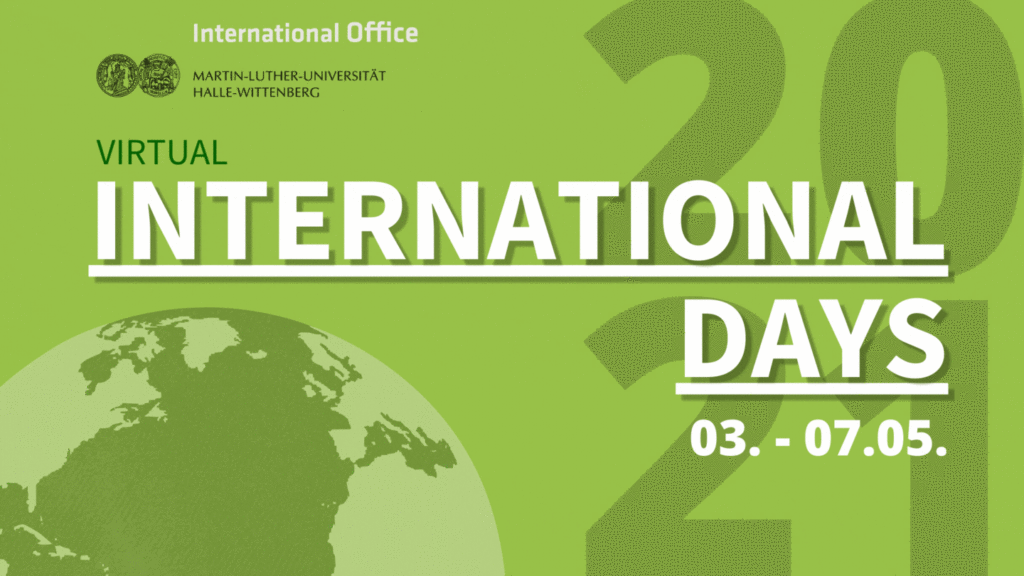
German as well as international students, PhD students and scientists who are planning a stay abroad or who are studying and researching at our university are cordially invited to participate in the Virtual International Days from May 03 to 07, 2021. During 5 days, the International Office together with external speakers will provide information on topics such as organization and financing of a semester, internship or research stay abroad, health insurance coverage, company pension plan and right of residence in Germany as well as on funding for international projects. In addition, you will have the opportunity to learn about the work of MLU’s foreign representative office in Almaty, Kazakhstan, as well as cooperation opportunities with this office.
The program is rounded off by online consultation hours and a pub quiz of the International Office as well as a casual get-together with ESN Halle. Please check the program, where you can also see which events will be held in English and for which prior registration is required.
Know-how on project management, business models: The Transfer and Entrepreneurship Service of Martin Luther University Halle-Wittenberg (MLU) bundles its information offerings on its own digital platform. In addition to basic knowledge for self-learning, exclusive webinars and online lectures will also be offered.