Für viele Wissenschaftler*innen stellt sich die Frage, ob nach Abschluss der Promotion noch länger an einer Wissenschaftskarriere gearbeitet werden sollte. Denn Wissenschaftskarriere in Deutschland ist schwierig: in der Regel geht es darum, den Weg zur Professur erfolgreich zu gehen. Da viele Promovierende und PostDocs nicht Professor*in werden, ist es in jedem Fall sinnvoll, einen Plan B zu haben und Alternativen zu kennen. Ziel des Workshops ist die Feststellung der eigenen Kompetenzen (fachliche und personale Kompetenzen) und der Klärung, wie zu diesem Kompetenzprofil passende Stellen auf dem außerakademischen Arbeitsmarkt gefunden werden können. Die Teilnehmenden sollen so in die Lage versetzt werden, nach dem Workshop weitere Ideen zu entwickeln, in welcher Form und mit welchen Inhalten sie in ihrem weiteren Berufsleben tätig sein wollen. Sie sollen außerdem ermutigt werden, die nächsten Schritte zu gehen.
[ Read On … ]3. Mar 2020
iDiv Summer School 2020 – Pollination Ecology (July 6-11, 2020 | cancelled)
We are happy to announce the iDiv Summer School 2020 “Pollination Ecology”, 6 to 11 July 2020, in Leipzig, Germany. This iDiv Summer School is led by Tiffany Knight and Amibeth Thompson, iDiv research group Spatial Interaction Ecology.
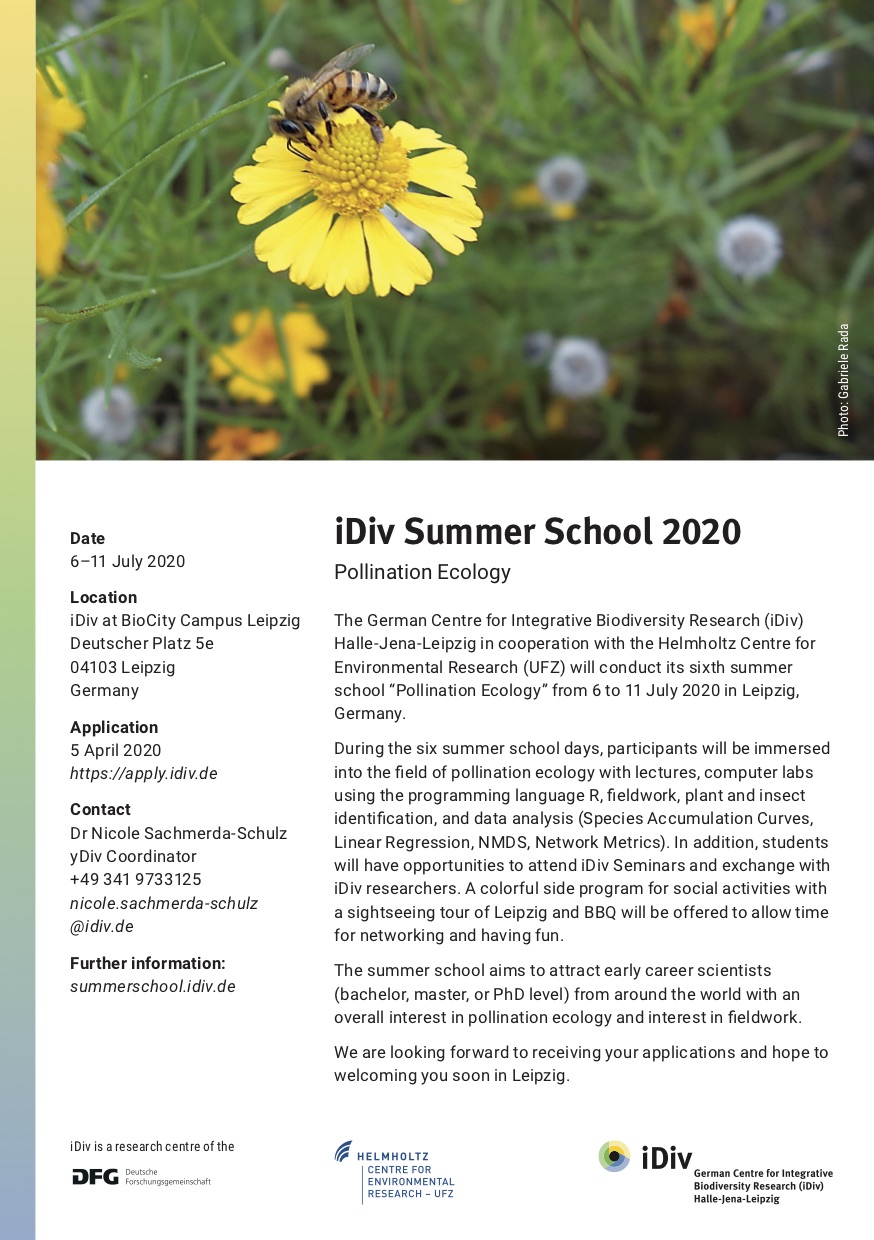
During the six summer school days, participants will be immersed into the field of pollination ecology with lectures, computer labs using the programming language R, fieldwork, plant and insect identification, and data analysis (Species Accumulation Curves, Linear Regression, NMDS, Network Metrics). In addition, students will have opportunities to attend iDiv Seminars and exchange with iDiv researchers.
The summer school aims to attract early career scientists (bachelor, master, or PhD level) from around the world with an overall interest in pollination ecology and interest in fieldwork.
The application deadline is Sunday, 5 April 2020.
For more information and the link for application, please visit summerschool.idiv.de.
3. Mar 2020
Vorstellungsgespräch und Gehaltsverhandlungen (May 27, 2020)
Wissen kann man sich anlesen, Erfahrung nicht. Da sich die meisten Akademiker gerne einlesen, sind die Antworten im Vorstellungsgespräch sehr ähnlich. Das hat zwei mögliche Konsequenzen: Der Personaler ist gelangweilt oder er fühlt sich durch die 08/15-Antworten provoziert. Beide Reaktionen haben meist ein gemeinsames Ende: Die Stelle bekommt jemand anderes.
Das Seminar zeigt auf, wie Sie sich ideal auf ein solches Gespräch vorbereiten, 08/15-Antworten vermeiden und wie Sie den Personaler mit Ihrer Persönlichkeit von sich und Ihren Gehaltsvorstellungen überzeugen.
Inhalte
- Die Teilnehmer/innen lernen mentale Lösungsstrategien in Stressinterviews.
- Durch Übungen wird die Schlagfertigkeit im Gespräch deutlich erhöht.
- Die Teilnehmer/innen lernen in Drucksituationen gelassen zu bleiben und angemessen zu reagieren.
- Jede/r Teilnehmer/in durchläuft ein Stressinterview, um seine erarbeiteten Strategien
„live“ zu testen und anschließend zu verbessern.
3. Mar 2020
Good Scientific Practice (May 7 & 14, 2020)
A cooperation of InGrA and PhD network.
Any responsible conduct of research should be based on honesty, accuracy, efficiency, and objectivity. The one-day workshop Good Scientific Practice focuses on these scientific standards of international research. It raises awareness of the subject matter by providing doctoral candidates with a set of professional values and ethical norms as well as required competencies and skills to pursue scientific integrity. The content of the course follows the curriculum “Safeguarding Good Scientific Practice” (Memorandum and Code of Conduct) of the Deutsche Forschungsgemeinschaft (DFG).
Specific Topics
- Introduction to good scientific practice
- Mentoring in the science system
- Misconduct in scientific research
- Conflicts of interest in scientific cooperation
- Data management
- Publication ethics
Aims
The workshop instructs participants on the principles of good scientific practice. Doctoral candidates learn how to comply with the international values and standards of good scientific research and ethical practice.
[ Read On … ]27. Feb 2020
Academic writing: How to create good texts (May 6-7, 2020)
A COOPERATION OF INGRA AND IRTG “Polymers: random coils and beyond”
For many young scientists writing is the most difficult part of research work. Poor structure, breakneck formulations and unclear argumentation lead to texts which are not too user friendly. However, for the success of academics it is essential that the content is successfully conveyed to the relevant target groups – from the subject community to the wider public.
The methods and instruments of scientific writing can be learnt. With a few select mechanisms for structuring and techniques for building arguments, it becomes possible to articulate even complex data clearly and comprehensibly. Coherently built up and convincingly formulated, even academic texts can be an exciting read!
Target audience
Doctoral students working in natural and life sciences
[ Read On … ]
17. Feb 2020
F***Up Night Halle (February 20, 2020)
Was ein Schlamassel – Unternehmer*innen reden übers Scheitern
20. Februar, 20 Uhr, leerstehendes Kaufhaus, Große Ulrichstraße 13 (ehemals „XENOS“)
Der Eintritt ist frei.
Bei der F***Up Night Halle erzählen Entrepreneure öffentlich über gescheiterte Projekte, Geschäftsmodelle, Ideen und berichten, welche Chancen und Erkenntnisse diese Rückschläge für sie mit sich brachten.
Auf der Bühne stehen diesmal:
[ Read On … ]13. Feb 2020
Introduction to Statistics and R (March 16-19, 2020) – cancelled
Content
R has become a leading statistical programming language in data science and statistics. The R software is free, highly extensible, and allows to easily produce publication-quality plots. The aim of this course is to equip participants with the basic skills to effectively use the software R, embedded in the user interface RStudio. These skills will cover data import, processing and data exploration, graphical representations with ggplot2, basic concepts of statistical inference and linear regression. All topics will be demonstrated in working examples and practiced with hands on examples.
The course will be split in two parts. In the first two days we are going to teach the basic functionality of R, RStudio, and ggplot2. Day three and four are dedicated to the application of statistical tests, which will be extended to linear mixed-effects models.
Target Group
Doctoral students and Postdocs which want to become acquainted with the R language and the basics of linear regression and model selection. No previous knowledge in R or statistics will be required.
[ Read On … ]